Configuration overview
ERun's configuration lives in three layers. Each layer holds different kinds of settings and is consulted at different points in the lifecycle.
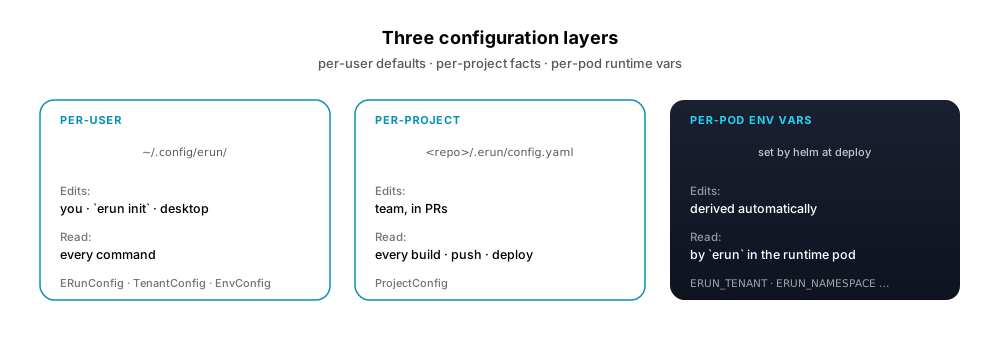
For exact file paths see Config locations. For the in-pod env var list see Environment variables. For how erun build resolves project root / context / version, see Build path resolution.
Per-user config
ERunConfig (<config-root>/config.yaml)
Global defaults that apply across all tenants.
| Field | Type | Used by | Effect |
|---|---|---|---|
default_tenant | string | erun (no args), erun open, erun list | Tenant used when no tenant argument is supplied. |
cloudproviders[] | list | erun init, erun open, erun cloud | Known cloud provider identities (alias, provider, account, profile, SSO/OIDC settings). provider is aws or cloudflare. AWS entries carry the SSO profile and OIDC issuer; Cloudflare entries carry an account ID and a token reference into the local secret store (the scoped API token itself is never stored in this file). Each cloud-bound env references entries by alias. |
cloudcontexts[] | list | erun open, erun deploy, erun cloud | Known managed cloud clusters. Each binds a cluster to a provider, region, and instance type/size. |
runtimeregistry.namespace | string | erun version, runtime image pulls | Overrides where ERun looks for erun-devops and related runtime images. Useful for internal mirrors (Harbor, ECR, Artifactory). |
runtimeregistry.repository | string | same as above | Overrides the repository name in the namespace. |
runtimeregistry.baseurl | string | same as above | Registry HTTP endpoint. Defaults differ for Docker Hub vs GHCR. |
runtimeregistry.tokenurl | string | same as above | GHCR token endpoint. Only used on the GHCR flow. |
execution.modes.<operation> | string | Operations with a library alternative (see Execution modes) | "library" switches that operation from its CLI subprocess to an equivalent Go library call; anything else (including unset) keeps the subprocess. |
openrouter.baseurl | URL | erun deploy, the in-pod runtime | The gateway every environment's Claude Code is routed through, such as https://openrouter.ai/api. Unset leaves each environment on its own Claude sign-in. Set, it renders ANTHROPIC_BASE_URL on every environment regardless of cloud provider — see Environment variables. |
openrouter.authtokenref | string | erun deploy | Name of the credential in ERun's own operator secret store — the same store the Cloudflare token uses. It is a reference and never the token itself, so this file stays safe to back up and share. Optional: leaving it empty uses claude-gateway. The value is what an operator sets (in the desktop's ERun settings); when none has been set, erun deploy reuses this machine's own Claude Code credential only when those settings already point at this same baseurl — a credential is scoped to the service it was issued for, so a key belonging to another gateway (or to a direct Anthropic login) is refused rather than sent here, and the deploy says which case it hit. Either way erun deploy writes the key into each environment's namespace as the Secret erun-claude-gateway, which is why nothing per-environment is named anywhere. |
openrouter.defaultmodel | string | The desktop's AI tab, erun open --ai | The catalog entry an environment selects when it has not chosen one. Ignored when it names no catalog entry, so a stale value cannot route an environment at a model the gateway no longer serves. |
openrouter.models[].id | string | The desktop's AI tab, erun open --ai | One selectable gateway model id. The list is what each environment's AI tab offers; an id the catalog omits can still be typed into that tab. |
openrouter.models[].context | int | erun deploy, the launcher | The context window Claude Code must assume for that id. A gateway id carries none of its own and the real windows differ between models, so this is deliberately per model rather than one environment-wide value. Use the provider-level figure, which can be smaller than an advertised maximum: declaring the larger headline lets a conversation grow past what the serving provider accepts, so the request fails with a too-long error instead of compacting cleanly. Empty leaves Claude Code's own assumption in place. |
The gateway catalog is one list the operator maintains and every environment selects from, rather than a per-environment setting:
# <config-root>/config.yaml
openrouter:
  baseurl: https://openrouter.ai/api
  authtokenref: claude-gateway
  defaultmodel: deepseek/deepseek-v4.1-flash
  models:
    - id: deepseek/deepseek-v4.1-flash
      context: 1048576
    - id: openai/gpt-6-astra
      context: 1050000
Choosing a model for one environment is separate from the catalog: the environment's claude.defaultmodel selects which entry its AI tab starts on, and the AI tab can also add a model id the catalog does not list.
The credential Secret is offered rather than recalled: ERun settings reads the environment namespaces (each on its own Kubernetes context, skipping host environments, which have no namespace) and lists the Secrets that exist, with each Secret's own key names, so a name that has to exist everywhere is picked rather than invented. A namespace that cannot be read is named in the dialog — a Secret whose access is denied must not read as a Secret that is missing.
A catalog that is not yet configured opens pre-filled from this machine's own Claude Code settings (~/.claude/settings.json, or CLAUDE_CONFIG_DIR when set): the gateway's base URL, the model those settings run on, and the context window they declare for it. Nothing is stored by opening the dialog — the operator still saves — and a catalog already configured is never overwritten. The credential is not read from those settings at all: they hold a token value, while the catalog names a Secret the pod resolves.
TenantConfig (<config-root>/<tenant>/config.yaml)
One per tenant.
| Field | Type | Used by | Effect |
|---|---|---|---|
name | string | All commands | Tenant identifier. |
defaultenvironment | string | erun (no args), erun open, erun list | Environment used when none is supplied. |
api_url | string | erun open (API port forward) | Backend API base URL for this tenant. |
cloudprovideraliases[] | list of strings | erun init, erun open | Cloud provider aliases the tenant is allowed to use. |
primarycloudprovideralias | string | erun open (suggesting cloud bindings) | Default cloud provider alias for new envs in this tenant. |
EnvConfig (<config-root>/<tenant>/<env>/config.yaml)
One per environment. This is the most-edited file.
| Field | Type | Used by | Effect |
|---|---|---|---|
name | string | All commands | Environment identifier. |
type | string (enum) | erun build, erun open, erun deploy, helm chart (worktreeStorage, ERUN_ENV_TYPE) | local-agent, remote-agent, runtime, or host. The canonical — and only — signal for what this env is for. Configs written before type existed are migrated to a concrete value on read (see Legacy migration). See Environment types. |
localRepoPath | string | helm chart (worktreeHostPath for local-agent envs), erun deploy (project-config load, registry resolution) | Absolute path to the repo on the local machine. Meaningful for local-agent and host envs (for host it names the directory the env is, with no pod to mount it into); left empty for remote-agent and runtime. |
repopath | string | (legacy, read-only) | Removed struct field. A repopath: in an older config is migrated into localRepoPath on read and dropped on the next save; new configs only carry localRepoPath. (Migration done.) |
kubernetescontext | string | erun open, erun deploy, erun list | Kubernetes context to deploy/open against. Special value in-cluster is set inside the runtime pod. |
containerregistries | list | erun build, erun push, erun deploy, build image tag resolution | Per-env marked registry list, set for remote-agent/runtime envs whose project config is not on the local machine (local-agent envs resolve the list from the project's .erun/config.yaml instead). Each entry is {registry, roles} where roles ⊆ build/from/to/deploy. See Container registries. |
cloudprovideralias | string | erun open, erun deploy, idle-stop, audit labels | Which AWS cloud provider identity backs this env. Resolves to a cloudproviders[] entry. |
cloudprovideraliases | map (provider → alias) | erun open, erun deploy | Additional cloud aliases attached to this env, keyed by provider type (e.g. cloudflare). AWS stays in the scalar cloudprovideralias above for backward compatibility; non-AWS providers live here. An env holds at most one alias per provider type, so a runtime pod can receive both an AWS identity and a Cloudflare token at once. A Cloudflare alias injects CLOUDFLARE_API_TOKEN / CLOUDFLARE_ACCOUNT_ID for in-pod tooling. |
managedcloud | bool | helm chart (ERUN_CLOUD_ENVIRONMENT) | When true, marks the env as running on a managed cloud context (enables idle-stop, cloud-credential refresh, etc.). |
runtimeversion | string | erun open, erun deploy, chart appVersion | Pins the version of the runtime image used by this env. |
runtimeregistry | string | erun open, erun deploy | Per-env override for where the environment resolves ERun's own artifacts: it is the first registry the runtime chart search probes, and it is projected into the pod as RUNTIME_REGISTRY for in-pod platform image resolution. Set it with erun init --runtime-registry <host> when the env's deploy-marked registry holds only your project's own images — ERun publishes charts/erun-devops beside the runtime image it releases, never beside your application images. A successful deploy or open records the registry the runtime chart actually resolved from here, so the next search starts there — but only to fill the field in or confirm it: a value you set is never replaced by a deploy that resolved somewhere else, which is traced instead. |
runtimeimage | string | erun open, erun deploy | Points the env's runtime pod at a custom image instead of the published <registry>/erun-devops:<version> default. A full reference (ghcr.io/acme/acme-runtime:1.2.3) is used verbatim; a bare name resolves to <registry>/<name>:<runtime version>. Set by erun init --runtime-image; carried to the published chart as imageOverrides.erun-devops on every deploy (see Advanced chart values). Optional for a tenant that publishes its own charts/<tenant>-devops umbrella — that deploy defaults the image to the umbrella's own <tenant>-devops image, so set runtimeimage only to pin a different image; an image-only env riding the shared charts/erun-devops chart still needs it. A value that resolves to the stock erun-devops image is ignored on an umbrella deploy (see Advanced chart values). |
runtimerunningimage | string | erun deploy (healed on every deploy of the runtime chart) | Display-only memo of the runtime image a deploy last actually resolved for this env's pod — the same value that lands on the release as imageOverrides.erun-devops, or the chart's own stock default when no override applied. Never read back to influence a deploy's own image choice (runtimeimage above is the field deploy reads for that); it exists only so a reader can tell which release line runtimeversion's number belongs to — ERun's own, or a tenant's own <tenant>-devops line, which can differ even between two environments of the same tenant. erun list renders it beside runtime-version as <version> (<line> line, <registry>/<image>), flags the case where the release name and the image disagree, and reads line undetermined when no deploy under this field has run yet (never guessed from the tenant or release name). See erun list · release lines. |
runtimechart | string | erun deploy, erun pin | Names the runtime chart this env rides, as an OCI reference that may carry its own version (oci://ghcr.io/sophium/charts/erun-devops:1.0.178). Set it when the runtime image is versioned on the project’s own release line rather than ERun’s: the chart is ERun’s artifact and exists only at ERun’s versions, so deriving both from runtimeversion names a chart that was never published and the deploy fails FetchReference … not found. With the chart stated here, runtimeversion keeps stamping the env and tagging the image, and each artifact is named on the line it ships on — see erun deploy · naming the chart and the image separately. Omit the :<version> suffix to name only a different registry, keeping the paired version. Empty (the default) keeps the published lookup at the runtime version, which is right whenever erun push published chart and image together. Overridable for one run with erun deploy --runtime-chart, which is not persisted. When it names ERun's own stock erun-devops chart at an explicit version, erun pin moves that version alongside runtimeversion on a re-pin, and a deploy to a newer version moves it the same way (recording the chart it installed) whenever the env's runtime image rides ERun's own line. A tenant's own charts/<tenant>-devops umbrella stated behind the deploy's version moves the same way — it is versioned on the tenant's own line, the one --version names — but only once that version is confirmed published for the chart; otherwise the stated version stays and the deploy reports that it is holding the umbrella back and why, since the runtime image moves to --version regardless (see erun deploy · naming the chart and the image separately). A chart naming a line --version is not on keeps its stated version. Editable in the desktop app under an environment’s Runtime tab (Runtime chart). |
mcpauthpublickeypath | string | erun deploy, erun init, erun open | Path to the PEM public key the env's erun-mcp edge verifies bearer tokens against — the desktop file:// path. Recorded by a deploy that enabled authentication (erun deploy --mcp-auth-public-key <path>, erun init --mcp-auth-public-key <path>) at the moment it applies the key to the cluster rather than after the rollout completes — so a rollout that fails afterwards still leaves the env naming the key its release trusts — and rethreaded by every later deploy of the runtime chart, so a plain version bump keeps the edge authenticated instead of falling back to the chart default. Cleared only by erun deploy --no-mcp-auth, once that unauthenticated release has rolled out. Empty means the env never had desktop MCP authentication. See erun deploy · MCP edge authentication is sticky. |
imagepullsecrets | list of strings | erun deploy, helm chart | Names Kubernetes dockerconfigjson secrets the runtime pod authenticates image pulls with — needed when the runtime image is a private registry package (e.g. a private <tenant>-devops umbrella image; ERun's own erun-devops/erun-dind images are public, so a default env needs none). Threaded to the chart as imagePullSecrets[i].name, re-scoped under the erun-devops subchart key for an umbrella. Empty (the default) leaves the pod pulling anonymously, so public-image envs are unaffected. Each named secret is re-minted from a host-resolved credential on every erun deploy when one is available (ECR via the AWS CLI, anything else via your local docker session) — see Advanced chart values. For a ghcr.io-hosted runtime image specifically, erun deploy no longer needs an entry here set up front at all: it auto-provisions and appends one on its own when a credential resolves, and refuses the deploy outright when none does and the image can't be confirmed public — see Private image pull secrets. |
mountsource | bool | erun deploy (runtime worktree storage + clone wiring), helm chart | Runtime-only opt-in for real-time patching: when true (together with repourl), the runtime pod gets a PVC-backed worktree it clones from repourl at the deployed release tag on first boot. A no-op without repourl, and ignored for agent envs (which already carry source). Default false keeps a runtime env sourceless (deploy-by-reference). Set from the desktop's Runtime tab → Mount source code. See Environment types → Hotfix pattern. |
repourl | string | erun deploy, helm chart (ERUN_REPO_URL) | Git remote the runtime pod clones when mountsource is set. Cloned into the in-pod worktree and checked out at v<runtimeversion> (the deployed release tag). |
autoupgrade | bool | erun upgrade, desktop Upgrade all | When true, this env joins the Upgrade-all set: erun upgrade redeploys it to the latest version for its channel when runtimeversion lags. |
disablebuildscript | bool | erun build, erun build --deploy | When true, erun ignores any project build.sh for this env and resolves docker/release builds directly; if there is no docker build context either, the build errors with no buildable context. Default false. |
platformaccount | bool | erun deploy, helm chart | When true, designates the env's runtime ServiceAccount as the cluster's erun platform admin: deploy threads --set platformAccount=true and the runtime chart binds the SA to the built-in cluster-admin ClusterRole (a <release>-platform ClusterRoleBinding). This is the grant that lets in-pod erun terraform apply of the cluster edge and platform component installs (cert-manager, Traefik, PowerDNS) create the cluster-scoped resources they require — namespaces, CRDs, cluster RBAC, webhooks. Default false leaves the SA with namespaced admin only. Set with erun init --platform-account. The first deploy that creates the binding must run from an admin-capable context — the API server's privilege-escalation check requires the creator already hold cluster-admin, so an in-pod self-deploy cannot bootstrap it. |
upgradechannel | string (enum) | erun upgrade | Release channel an upgrade targets: stable (semver releases) or snapshot (latest snapshot build, or the stable release once one is published on top of it — see erun upgrade). Orthogonal to type. When unset, defaults from type — runtime → stable, agent → snapshot. |
stopped | bool | erun stop, erun open, erun deploy, helm chart (stopped) | Records that the Operator stopped this environment. erun stop sets it and scales the runtime Deployment to zero; erun open clears it and scales back up. deploy renders the chart's stopped value from it, so the chart emits replicas: 0 and a helm upgrade reconciles the stop instead of silently restarting the pod — a bare scale patch alone would be drift the next upgrade reverts. deploy therefore never wakes an environment; opening it does. Clearing the field is an Operator gesture: erun open --reconnect, the form a supervisor uses to re-establish a dropped session, leaves it set (see erun open), so a stop is not erased by the reconnects the stop itself triggers. Default false. |
runtimepod.cpu | string | helm chart (runtime.resources.limits.cpu) | CPU limit for the runtime pod (e.g. 4, 500m). |
runtimepod.memory | string | helm chart (runtime.resources.limits.memory) | Memory limit (e.g. 16384Mi, 2Gi). Default 16384Mi: agents run make check-gate in this container, which is the same ten-target gate the erun-dind sidecar runs during an image build (see the row below). Trim it for an env that only serves an app; raise it with erun resize --memory if the cgroup reports OOM kills. |
runtimedindpod.cpu | string | helm chart (runtime.dind.resources.limits.cpu) | CPU limit for the erun-dind sidecar — the container that actually runs erun build/erun release, independent of runtimepod.cpu. Default 12, which is a sizing rule rather than a fixed number: the node's CPUs divided across the build-capable environments erun expects to be building on it at once, floored at 4 (see Sizing the build CPU cap). A limit is a ceiling, not a reservation, so size it for the node — a cap well under the node throttles the build while the node sits idle. Set with erun init --dind-cpu / erun resize --dind-cpu. |
runtimedindpod.memory | string | helm chart (runtime.dind.resources.limits.memory) | Memory limit for the erun-dind sidecar — every image build's make check gate runs here, against a measured peak the runtime container's own default is sized from. Default 20Gi; raise it further if a release still reports resource exhaustion inside the sidecar. Set with erun init --dind-memory / erun resize --dind-memory. |
sshd.enabled | bool | erun open, chart (SSH port-forward setup) | Whether the in-pod SSH server is exposed via port forward. Needed for IDE attach. |
sshd.localport | int | erun open | Local port the desktop binds for the SSH forward. 0 = auto-allocate. |
sshd.publickeypath | string | erun open --vscode, erun open --intellij, SSH key sync | Path to the SSH public key authorized for the env. |
sshd.workspacesync.enabled | bool | desktop workspace-sync poller | Mirror a local folder into the runtime workspace. |
sshd.workspacesync.localpath | string | desktop workspace-sync poller | The local folder to mirror. |
deploy.timeout | duration (e.g. 5m0s) | erun deploy, erun upgrade (helm --timeout) | Per-env helm rollout wait. How long deploy waits for the rollout to become ready before helm times out; the pod monitor keeps waiting up to this bound while an image is still pulling and aborts earlier on a real failure. Unset → 15m0s, the bound on a cold pull of the runtime image (the chart replaces its pod with strategy: Recreate, so the rollout waits it out with the environment running nothing). Overridden per-deploy by --rollout-timeout / the MCP deploy timeout input. A malformed value fails the deploy. |
deploy.components | list | erun deploy | Per-machine saved deploy selection: the charts erun deploy rolls out for this env by default (chart directory names under <tenant>-devops/k8s/, plus the runtime release name <tenant>-devops). Set it with erun init --components <a,b,…>, or from the desktop app's Runtime-tab checklist (inside the Version-to-deploy picker, gated until you pick a version, "Set as default"). It is a published-version view, the same for every env type: once you pick a version it offers the component charts actually published at that version (plus the runtime) — the version, not the env's local source, decides which charts exist, so a version that never published a chart doesn't list it, and a local-agent env shows the same published components as a runtime env rather than its local working-tree chart directories. (Deploying local working-tree charts by name stays available to an operator via the CLI.) Unchecking every chart in the checklist is not the same as leaving the selection unspecified: the checklist refuses an empty selection rather than let it fall through to the runtime chart alone, so its Deploy stays disabled with the reason named until at least one chart is checked. Deploy is opt-in: --components overrides this per run; when both are empty, deploy falls back to the project's k8s.deployments plan, then to the runtime chart alone. See selection precedence. Empty → no saved selection. Because a saved selection wins over the plan permanently and tiers never merge, a plain deploy (no --components) sourced from the saved set refuses whenever the plan names something the saved set omits, tracing deploy: saved components shadow the repo plan; plan also names <a, b, …> and naming the fix: adopt the addition with erun init --components <a,b,…>, or clear the saved selection with erun init --components '' to return to the plan outright. --components passed explicitly for that one run bypasses the refusal (and the saved selection) entirely. |
idle.timeout | duration (e.g. 5m0s) | chart (ERUN_IDLE_TIMEOUT), in-pod idle monitor | How long the env must be quiet before idle-stop fires. |
idle.workinghours | string (HH:MM-HH:MM) | chart (ERUN_IDLE_WORKING_HOURS), idle monitor | Window during which idle-stop is allowed to fire. |
idle.timezone | string | chart (ERUN_IDLE_TIMEZONE), idle monitor | Time zone for workinghours. |
idle.idletrafficbytes | int64 | chart (ERUN_IDLE_TRAFFIC_BYTES), idle monitor | Bytes/window below which the env is considered network-quiet. |
claude.usemantle | *bool | chart (CLAUDE_CODE_USE_MANTLE) | Route Claude through Mantle. |
claude.usebedrock | *bool | chart (CLAUDE_CODE_USE_BEDROCK) | Route Claude through AWS Bedrock. |
claude.models[] | list | chart (ERUN_CLAUDE_AVAILABLE_MODELS) | Allow-list of Claude models for in-pod tools. |
claude.maxoutputtokens | *int | chart (CLAUDE_CODE_MAX_OUTPUT_TOKENS) | Max output tokens per Claude response. |
claude.effort | *string | desktop AI launcher (claude --effort / claude --settings) | Effort level for the env's Claude AI tab, one of low, medium, high, xhigh, max, ultracode. Unset or invalid → ultracode. The five --effort levels launch as claude --effort <level>; ultracode is not an --effort value — it launches as claude --settings '{"ultracode":true}' and enables xhigh effort plus standing multi-agent workflow orchestration. Only the default Claude launch is affected; a non-claude aitool or a Claude launch the Operator wrote with explicit flags is left untouched. Saving a change from the desktop reopens the env's open AI tabs; the session resumes via --continue. |
claude.defaultmodel | *string | desktop AI launcher (claude --model) | Model the env's Claude AI tab starts on. Applied while it is one of the env's available models (claude.models[], or the default available set when that list is empty); when unset — or set to a model no longer in that set — the launch falls back to the first available model (opus by default) rather than passing no --model, so a managed session never defers to Claude Code's own default model (Fable), which erun's pod auth does not serve. Model names are opaque tokens to ERun — resolving one (e.g. fable) to a concrete model is Claude's concern. fable stays strictly opt-in: it is never in the default available set and launches only when the Operator both lists it under claude.models[] and selects it here. The resolved model is also mirrored into CLAUDE_CODE_SUBAGENT_MODEL on the launch, so subagents spawned inside that session run on the env's model instead of Claude Code's separate subagent default; it is left unset only when no available model is a usable token. Same verbatim-launch carve-out and save-reopen behaviour as claude.effort. |
claude.usegateway | *bool | chart (the gateway env block), desktop AI launcher | Whether this environment uses the erun-level gateway catalog (see openrouter). Unset inherits the operator's erun-level decision, so the environment follows it; false keeps this one environment on its own Claude sign-in while every other environment still uses the gateway. The catalog is one erun-level list rendered for every environment, so without this an environment could only be moved off the gateway by moving all of them. |
claude.verbosedebug | bool | desktop AI launcher (claude --verbose --debug) | Launch the env's Claude AI tab with Claude's own verbose + debug diagnostics streaming into the tab. Absent means off. Same verbatim-launch carve-out and save-reopen behaviour as claude.effort. |
aitool | string | desktop AI launcher, runtime entrypoint | Which Agent is the default for this env (claude, codex, …). |
localportrangestart | int | desktop port allocator | Base port for this env's local forwards (MCP, API, SSH). |
autostart | *bool | desktop sidebar open | nil = ask, true = always start linked cloud context on open, false = never. |
remotehostcredentials | bool | — (deprecated no-op) | Deprecated. Host AWS credential delivery now follows AWS-alias attachment: attaching an AWS cloud alias to an env delivers its credentials into the runtime pod (the alias association is the opt-in — "act on my behalf here"), so no separate toggle is needed. Retained only so existing configs still parse; setting it has no effect. |
What a host env leaves unset
A host env (see Environment types → host) has no pod and no cluster at all, so erun init --type host records only name, type, and localRepoPath — every other field above stays empty rather than being filled with a value that would never be read. Concretely: kubernetescontext, containerregistries, cloudprovideralias(es), managedcloud, runtimeversion, runtimeregistry, runtimeimage, runtimerunningimage, runtimechart, mcpauthpublickeypath, imagepullsecrets, mountsource/repourl, platformaccount, stopped, runtimepod.*, runtimedindpod.*, sshd.*, and idle.* are all pod/cluster-shaped and meaningless for host — erun deploy, erun pin, and erun terraform refuse a host env outright rather than resolving a plan from them. upgradechannel resolves to snapshot by its type default (host, like the two agent types, iterates on snapshot builds) but is moot in practice: erun upgrade skips a host env even if autoupgrade is set, the same way it skips a not-opted-in env, since there is no runtime version to redeploy. The desktop's Init dialog hides the fields above entirely when Host is selected, so this is enforced at the point of entry, not just documented after the fact.
The four claude.* rows above (usemantle, usebedrock, models[], maxoutputtokens) are the Claude values erun manages itself. The runtime chart accepts further claude.* values that erun never sets — pin a model, point Bedrock at a VPC endpoint, tune prompt caching — via the env's values overlay; see Advanced chart values.
The env's Claude AI tab also launches with Remote Control enabled by default: the managed launch appends --remote-control <tenant>/<env> after the effort/model/verbose flags, so the session is drivable from the Claude iOS app under that name. It is omitted when claude.usemantle or claude.usebedrock is set — Remote Control pairs through the claude.ai account relay, which those gateway auth modes can't authenticate — and follows the same verbatim-launch carve-out as claude.effort (a non-claude aitool, or a Claude launch written with explicit flags, is left untouched). An environment name that isn't a plain token (alphanumerics, ., -, _, starting with an alphanumeric) falls back to the unnamed --remote-control, leaving Claude Code to name the session from the pod hostname. For the Operator view, see Desktop app · Working with an Agent.
Per-project config
ProjectConfig (<repo>/.erun/config.yaml)
Committed to the repo, applies to anyone who checks it out. A gitignored copy defeats that: git never sees it, so it resolves on the one machine that wrote it and nowhere else — the file still exists on disk and every command that reads it succeeds silently. erun build, erun deploy, and erun doctor each detect this via git check-ignore against .erun/config.yaml and report it rather than resolving silently:
erun build/erun deploytraceconfig: .erun/config.yaml is excluded by .gitignore -- this resolves only on this machine; replace a bare ".erun/" ignore with ".erun/*" plus "!.erun/config.yaml"(visible at default verbosity, in real runs and--dry-runalike).erun doctorreports the same finding under an== Project config ==heading.- The fix names the actual trap: a bare
.erun/directory ignore cannot be negated per file in git (!.erun/config.yamlalone would never re-include a file inside an already-ignored directory), so the remedy is.erun/*(ignore each entry individually) plus!.erun/config.yaml(re-include the one file that must be tracked). - Detection is best-effort: outside a git repository, or when
gitis unavailable, no warning is produced and the config still resolves from disk as it always did.
| Field | Type | Used by | Effect |
|---|---|---|---|
containerregistries | list | erun build, erun push, erun deploy, build image tag resolution | Project-wide marked registry list. Each entry is {registry, roles} with roles ⊆ build/from/to/deploy. See Container registries. |
environments | map | per-env settings (below) | Map of <env-name> → ProjectEnvironmentConfig. |
environments.<env>.containerregistries | list | erun build, erun push, erun deploy | Per-env marked registry list override. Higher precedence than the top-level project list. |
environments.<env>.docker.fingerprints | map | erun build, erun build --release | Per-image content fingerprints from the last published build. Drives the fingerprint cache. |
docker.platforms | list | erun build | Project-wide default for the docker --platform targets of a local build (e.g. [linux/amd64]), inherited by every environment that declares no platforms of its own — for a project whose machines can only ever run one architecture. Declare it once here instead of repeating it per environment, which silently leaves any environment nobody listed on the multi-arch build. It narrows only what a local build mints: publishing never consults it, because erun build --release and erun push both resolve every platform erun supports, so a published version always carries all of them. See Multi-architecture. |
environments.<env>.docker.platforms | list | erun build | Pins the docker --platform targets for a local build in this env (e.g. [linux/amd64]), overriding the project-wide docker.platforms default. An explicit empty list (platforms: []) opts this env out of that default and keeps the multi-arch build — the escape hatch for a generic env name like local that can belong to a machine of any architecture. --platform on the command line overrides both for one invocation. Never applies to erun build --release or erun push, which always resolve every platform erun supports. See Multi-architecture. |
docker.secrets | list | erun build, erun push, erun build --release | Project-wide default for the BuildKit build secrets every build receives, inherited by every environment that declares no secrets of its own. Each entry is {id, env} or {id, src}. |
environments.<env>.docker.secrets | list | erun build, erun push, erun build --release | Pins the build secrets for builds in this env, overriding the project-wide docker.secrets default. An explicit empty list (secrets: []) opts this env out of that default. |
environments.<env>.k8s.deployments[] | ordered list | erun deploy | The ordered deploy plan for this env. Each step is either a single component name or a list of names deployed in parallel. |
release.mainbranch | string | erun release | Main branch name (default main). |
release.developbranch | string | erun release | Develop branch name (default develop). |
platform | map | erun deploy (PowerDNS), erun expose | Per-instance platform deployment config. Absent for non-platform projects. See platform: block. |
paths | map | erun build, erun push, erun deploy, erun e2e, erun terraform | Overrides where erun discovers the devops assets — the docker/, k8s/, and playwright/ folders, the terraform-<tenant> root, and the VERSION file. Absent → the conventional layout. See paths: block. |
components | map | erun build, erun push, erun deploy, erun e2e | Declares more than one paths:-shaped root, keyed by component name, for a monorepo of independent deployables that do not share one docker/k8s/playwright root. Absent → paths: is the project's only root, unchanged. See components: block. |
paths: block
The paths: block relocates the devops assets erun otherwise discovers by convention: the docker/ build contexts and k8s/ Helm charts under <tenant>-devops/, the per-environment Terraform roots at terraform-<tenant>/ (or <tenant>-devops/terraform-<tenant>/), and the VERSION file. It is project-global (not per-environment). Reach for it when a repo does not nest these under a <tenant>-devops/ module — for example a devops repo whose root carries docker/, k8s/, terraform-<tenant>/, and VERSION as top-level siblings.
Every field is optional; an unset field keeps the conventional location. A configured path resolves relative to the project root (an absolute path is used as-is). The override relocates the canonical folders, it does not rename them: the docker/ and k8s/ directories keep those exact names (erun's build and deploy machinery keys off the folder name), so a configured docker/k8s path must end in a docker/k8s segment. One field, dockercontext, is not a path but a mode selector for how the Docker build context is chosen.
| Field | Type | Default | Effect |
|---|---|---|---|
docker | string | <tenant>-devops/docker | Directory (named docker) whose subdirectories are the per-component build contexts (<docker>/<component>/Dockerfile). Read by erun build / erun push. |
dockercontext | repo-root | component | positional heuristic | Selects the Docker build context root, overriding the positional heuristic (see Build context directory). repo-root → context is the project root (so a Dockerfile can COPY from anywhere in the repo); component → context is the component build dir. Unset keeps the heuristic. Read by erun build / erun push / erun release. |
k8s | string | <tenant>-devops/k8s | Directory (named k8s) whose subdirectories are the per-component Helm charts (<k8s>/<component>/Chart.yaml). Read by erun deploy, and by erun build for chart packaging. |
terraform | string | terraform-<tenant> or <tenant>-devops/terraform-<tenant> | Base directory under which the per-environment Terraform roots live; erun still appends /<environment>. Read by erun terraform, which by convention checks terraform-<tenant>/ then <tenant>-devops/terraform-<tenant>/ (the same -devops discovery as docker/k8s) before this override is needed. |
version | string | walk up from the build dir to the project root | Path to the VERSION file that mints the build version. A directory resolves to <dir>/VERSION. Read by erun build / erun push / erun release. |
playwright | string | <tenant>-devops/playwright | Directory (named playwright) holding the project's e2e suite — either a Playwright project directly, or per-component subdirectories (<playwright>/<component>/playwright.config.ts) mirroring docker/k8s. Read by erun e2e. |
# <repo>/.erun/config.yaml — a devops repo that holds the folders at its root
paths:
  docker: docker
  k8s: k8s
  terraform: terraform-frs
  version: VERSION
Error behaviour. A configured override that does not resolve fails the command (exit code 1) rather than silently falling back to convention:
paths.docker/paths.k8s/paths.playwrightpointing at a directory that is missing, not nameddocker/k8s/playwright, or holding no build contexts / charts / suites →configured docker path "<p>" (.erun/config.yaml paths.docker) is not a docker build module: …(and thek8s/playwrightanalogues).paths.terraformwith no<base>/<environment>/directory →no Terraform root at <dir> … the .erun/config.yaml paths.terraform base "<p>" must contain a <env>/ dir ….paths.versionpointing at a missing file →configured version file <p> (.erun/config.yaml paths.version) not found.paths.dockercontextset to anything other thanrepo-rootorcomponent→invalid docker context "<v>" (.erun/config.yaml paths.dockercontext): expected "repo-root" or "component".
components: block
The components: block declares more than one paths:-shaped root, keyed by component name, for a monorepo of independent deployables that do not share one docker/k8s root — a repo shaped like harnesses/<name>/{docker,k8s}, where each harness carries its own docker/, k8s/, and VERSION. paths: cannot express this: it is a single, project-global root, so a repo with N independent harnesses could commit only one of them at a time. components: is additive — present only for a repo that needs it — and each entry is exactly paths:-shaped (docker, dockercontext, k8s, terraform, version, playwright), reusing the same fields and resolution rules documented above. A project with no components: map keeps resolving through paths: exactly as before this block existed.
# <repo>/.erun/config.yaml — a monorepo of independent harnesses
components:
  platform-validator:
    docker: harnesses/platform-validator/docker
    k8s: harnesses/platform-validator/k8s
    version: harnesses/platform-validator/VERSION
  ingest-worker:
    docker: harnesses/ingest-worker/docker
    k8s: harnesses/ingest-worker/k8s
    version: harnesses/ingest-worker/VERSION
Selection. erun build and erun push take --component <name> to select one entry; the selected entry's docker/dockercontext/version then resolve exactly like the paths: block's fields, scoped to that root. Selection is committed in .erun/config.yaml, not per-machine — two operators working on different harnesses in the same repo need no local edit, only a different flag.
- Exactly one
components:entry and no--component→ that entry auto-selects, mirroring today's implicit single-paths:behavior. - More than one entry and no
--component→ the build fails naming the declared choices, rather than silently resolving one. --component <name>naming an entry the project does not declare → fails naming the declared choices.
erun deploy's existing component selection (--components <name>,…, or the environments.<env>.k8s.deployments[] plan — see the field table above) resolves each named component's chart through components.<name>.k8s when that name is declared, instead of walking the whole project for a same-named chart — this only narrows where the chart is found (to the declared root) and never changes which chart a name selects for a project that declares no matching entry.
Error behaviour. Same shape as the paths: block, with the config key naming the specific entry:
--component <name>when.erun/config.yamldeclares nocomponents:map, or none named<name>→component "<name>" not declared in .erun/config.yaml components (declared: <names, or "none">).- No
--componentand more than one entry declared →ambiguous component selection: .erun/config.yaml declares <N> components (<names>); pass --component <name>. - A selected entry's
docker/k8s/version/dockercontextthat fails to resolve reports the same errors as thepaths:block, with the config key written ascomponents.<name>.<field>instead ofpaths.<field>.
platform: block
The platform: block configures an erunpaas platform deployment — an installation that runs the global singletons (the PowerDNS nameserver, the hosted IdP) and exposes tenant services under a delegated zone. ERun's platform is generic, installable software: any vendor deploys it under their own names, so every value is configuration — nothing (not even the base domain) is hardcoded. erun deploy threads these as platform.* helm values (the erun-powerdns and erun-zitadel charts read them); erun expose reads them to resolve service hostnames.
The whole block is optional. An empty block means the project runs no platform deployment. Once any field is set the block is "in use" and is validated at deploy/expose time — a malformed block fails fast.
| Field | Type | Required | Effect / default |
|---|---|---|---|
basedomain | string | yes (when block in use) | The registered domain this deployment serves, e.g. erunpaas.com. Everything else derives from it. Must be a valid domain name. |
env | string | no | The dedicated platform environment that owns the singletons (PowerDNS, the DNS-01 broker), e.g. frs-prod. Must be a DNS-safe <tenant>-<env> namespace label. |
serviceszone | string | no | The child zone delegated to this deployment's PowerDNS, under which tenant services are exposed. Default services.<basedomain>. Must be a valid domain at or under basedomain. |
authoritativeip | string | no | The public IP this deployment's authoritative nameserver answers on (the glue-record target for serviceszone). Must parse as an IP when set. |
nameservers | list | no | The NS hostnames the parent zone delegates serviceszone to. Default [ns1.<basedomain>, ns2.<basedomain>]. |
authhost | string | no | The hosted-IdP host, served from the apex zone (not serviceszone). Default auth.<basedomain>. Must be a valid domain at or under basedomain. The erun-zitadel chart issues tokens for this origin, and a platform deploy adds https://<authhost> to the API's ERUN_OIDC_ALLOWED_ISSUERS so the control plane trusts its own IdP. |
acmeemail | string | no | The account email for this deployment's Let's Encrypt registration (LE rate limits are per registered domain, so each deployment uses its own account). |
caaissuer | string | no | CA domain the services zone authorizes via apex CAA records (issue + issuewild), e.g. letsencrypt.org. Empty (default) writes no CAA — any CA may issue. Opt-in because it must match the CA the cluster edge's ACME server uses; a mismatched CAA blocks issuance. When set, the erun-powerdns zone-bootstrap also gives per-env empty-non-terminal names a definitive CAA answer instead of an ambiguous NODATA. |
apiurl | string | no | This deployment's own API base URL, e.g. https://api.frs-prod.services.erunpaas.com. Served unauthenticated at GET /v1/platform so a client can discover it; an unset value renders as an empty string, never an error. |
consoleurl | string | no | This deployment's hosted web console URL. Same discovery contract as apiurl. |
brand | string | no | This deployment's display name, if set. Same discovery contract as apiurl. |
docsurl | string | no | The documentation site this deployment's own surfaces link to, e.g. https://docs.erunpaas.com. Default https://docs.<basedomain>. Must be an absolute http/https URL when set; a trailing slash is normalized away. Same discovery contract as apiurl. |
tagline | string | no | The one-line pitch this deployment's signed-out landing page leads with. Unset leaves the client's bundled product tagline in place. Same discovery contract as apiurl. |
logourl | string | no | Absolute URL of this deployment's logo, e.g. https://erunpaas.com/logo.svg. It is a URL rather than a path the platform serves, because one built console image serves every instance and carries no brand asset. Must be an absolute http/https URL when set; unset — or a URL the browser cannot load — leaves the client's generic mark. Same discovery contract as apiurl. |
# <repo>/.erun/config.yaml
platform:
  basedomain: erunpaas.com
  env: frs-prod
  authoritativeip: 203.0.113.10
  caaissuer: letsencrypt.org   # optional; authorizes only this CA on the zone
  apiurl: https://api.frs-prod.services.erunpaas.com     # optional; served at GET /v1/platform
  consoleurl: https://console.frs-prod.services.erunpaas.com # optional; served at GET /v1/platform
  brand: Acme                                            # optional; served at GET /v1/platform
  tagline: Ship it, prove it.                            # optional; else the bundled product tagline
  logourl: https://acme.example/logo.svg                 # optional; else a generic mark
  # serviceszone, authhost, docsurl, and nameservers default from basedomain:
  #   serviceszone: services.erunpaas.com
  #   authhost:     auth.erunpaas.com
  #   docsurl:      https://docs.erunpaas.com
  #   nameservers:  [ns1.erunpaas.com, ns2.erunpaas.com]
A second vendor installs the same artifacts under their own names — e.g. basedomain: kppaas.com, env: kp-prod — with no code changes.
Error behaviour. The block is validated when erun deploy/erun expose resolves the plan, before any chart work, and a malformed value fails the command (exit code 1) rather than being threaded onward:
basedomainunset while any other field is set →platform config: basedomain is required when a platform block is set.basedomain/serviceszone/authhostnot a valid domain, or a host not at or underbasedomain→platform config: serviceszone "<v>" must be "<basedomain>" or a subdomain of it.authoritativeipthat does not parse as an IP →platform config: authoritativeip "<v>" is not a valid IP address.envthat is not a DNS-safe namespace label →platform config: env "<v>" must be a DNS-safe namespace label (lowercase letters, digits, and hyphens).docsurl/logourlthat is not an absolutehttp/httpsURL →platform config: logourl "<v>" must be an absolute URL including the scheme and host, for example "https://<basedomain>/logo.svg". These values are rendered by a browser as a link and an image, so a bare host or a relative path would become a dead link the page itself cannot explain — the message names the shape expected and an example under this deployment's own domain.
Per-pod env vars
The helm chart writes these into the runtime pod at deploy time. They're derived from the per-user and per-project layers above; you don't edit them directly. Full list at Environment variables.
Advanced chart values (Operator escape hatches)
The runtime chart accepts more values than erun manages. At deploy time erun passes two layers to helm upgrade --install:
- The env's values overlay —
values.<env>.yamlin the runtime chart directory (<tenant>-devops/k8s/<tenant>-devops/values.<env>.yaml). It is passed with-fand is required: deploy aborts withvalues file not found for environment "<env>"when it is missing. Environments that deploy the publishederun-devopschart have no local chart directory; for them the overlay lives next to the env's config at<UserConfigDir>/erun/<tenant>/<environment>/values.yaml(e.g.<config-root>/<tenant>/<environment>/values.yamlon Linux) and is optional — when absent, the chart defaults plus erun's--setlist fully describe the deploy. - erun's own
--set/--set-stringlist, derived fromEnvConfigand the resolved plan.
Helm gives --set precedence over -f, so for every key erun manages the overlay can never win. The keys below are exactly the ones erun's --set list never includes — for them the values.<env>.yaml overlay is authoritative, which makes it the supported escape hatch for behaviour erun doesn't model.
claude.* model and Bedrock tuning
Each value renders as an env var on the runtime container, and the pod's entrypoint relays it into the Agent's ~/.claude/settings.json. Both steps are AWS-gated: the chart renders this env block only when the env's cloud provider is aws (cloudContext.provider), and the entrypoint relay runs only when Bedrock configuration is active — an AWS provider, or CLAUDE_CODE_USE_BEDROCK / CLAUDE_CODE_USE_MANTLE set, with a resolvable region.
An erun-level gateway (openrouter) is the exception: it routes Claude through a provider the environment config selects rather than through an AWS service, so its variables render for every environment regardless of cloud provider and its own values are --set by erun rather than set through this overlay.
| Chart value | Env var | Default | Effect |
|---|---|---|---|
claude.model | ANTHROPIC_MODEL | unset | Pin the primary model Claude uses. |
claude.defaultOpusModel | ANTHROPIC_DEFAULT_OPUS_MODEL | unset | Pin the model ID the opus alias resolves to (Bedrock model IDs, anthropic.-prefixed). |
claude.defaultSonnetModel | ANTHROPIC_DEFAULT_SONNET_MODEL | unset | Pin the model ID the sonnet alias resolves to. |
claude.defaultHaikuModel | ANTHROPIC_DEFAULT_HAIKU_MODEL | unset | Pin the model ID the haiku alias resolves to. |
claude.bedrockBaseURL | ANTHROPIC_BEDROCK_BASE_URL | unset | Route Bedrock traffic through a VPC endpoint or gateway instead of the public endpoint. |
claude.mantleBaseURL | ANTHROPIC_BEDROCK_MANTLE_BASE_URL | unset | Base URL for the Bedrock Mantle gateway. |
claude.bedrockServiceTier | ANTHROPIC_BEDROCK_SERVICE_TIER | unset | Bedrock service tier: default, flex, or priority. |
claude.skipMantleAuth | CLAUDE_CODE_SKIP_MANTLE_AUTH | unset | Skip Mantle's own auth step (set 1 when the gateway handles auth). |
claude.disablePromptCaching | DISABLE_PROMPT_CACHING | unset | Turn prompt caching off (set 1). |
claude.enablePromptCaching1H | ENABLE_PROMPT_CACHING_1H | unset | Use the 1-hour prompt-cache TTL on Bedrock (set 1). |
claude.maxThinkingTokens | MAX_THINKING_TOKENS | 1024 | Thinking-token budget per response. |
claude.smallFastModelAWSRegion | ANTHROPIC_SMALL_FAST_MODEL_AWS_REGION | cloudContext.region | AWS region for the small/fast helper model, when it differs from the env's region. Like AWS_REGION, the env var is emitted only when a region resolves — see Environment variables. |
The claude.* keys erun does manage — claude.useBedrock, claude.useMantle, claude.availableModels, claude.maxOutputTokens — come from the EnvConfig fields above and are always --set; an overlay value for them is ignored.
Runtime pod resource requests
erun manages only the runtime pod's and erun-dind sidecar's resource limits: EnvConfig.runtimepod.cpu/.memory and EnvConfig.runtimedindpod.cpu/.memory (set with erun init --runtime-cpu/--runtime-memory/--dind-cpu/--dind-memory, erun resize, or the desktop's env settings) are always --set as runtime.resources.limits.{cpu,memory} and runtime.dind.resources.limits.{cpu,memory} respectively. The requests are overlay-only for both containers:
| Chart value | Default | Effect |
|---|---|---|
runtime.resources.requests.cpu | 0.25 | CPU request for the runtime pod. |
runtime.resources.requests.memory | 1024Mi | Memory request for the runtime pod. |
runtime.dind.resources.requests.cpu | 0.25 | CPU request for the erun-dind sidecar. |
runtime.dind.resources.requests.memory | 1024Mi | Memory request for the erun-dind sidecar. |
Request overrides are invisible to erun open's redeploy drift detection — it compares the deployed limits against EnvConfig.runtimepod and ignores requests — so changing a request in the overlay takes effect on the next deploy, not automatically on the next open.
Runtime image override
imageOverrides.erun-devops is a supported public value of the runtime chart: it replaces the image the erun-devops container runs while keeping the rest of the chart canonical. The supported way to set it is the EnvConfig.runtimeimage field (erun init --runtime-image), which erun passes as --set-string imageOverrides.erun-devops=<image> on every deploy of the published chart — the intended path for custom toolchain images built FROM the published erun-devops image (the erun-build-env skill walks through it).
When runtimeimage is unset, erun defaults the override from the chart it is deploying: a deploy of the tenant's own published charts/<tenant>-devops umbrella defaults imageOverrides.erun-devops to that umbrella's own image, <registry>/<tenant>-devops:<version>. erun push publishes the umbrella and its <tenant>-devops image together at one version, so the chart's identity names the image — building and pushing it is enough for the deploy to run it, with no runtimeimage to set and no silent fall-back to a stock erun-devops:<version> the tenant's version line never published. A deploy of the shared charts/erun-devops chart carries no such signal: with runtimeimage unset it passes no override (the chart's own default image runs, and the overlay may set the value directly), so an image-only build env still points at its image through runtimeimage.
An explicit runtimeimage normally wins over that default — the operator's choice. Two cases are treated as stale leftovers rather than a deliberate current choice, and are ignored in favour of the default above:
- The shared-chart-to-umbrella migration: on a
<tenant>-devopsumbrella deploy, aruntimeimagethat resolves to the stockerun-devopsimage (any registry) is a leftover from when the env rode the shared chart — the tenant's version line never publisheserun-devops, so honouring it would pin a tag that 404s (ImagePullBackOff). Trace:deploy: ignoring stale runtimeimage <image> on the <tenant>-devops umbrella deploy …. - A
runtimeimagethat names the very same image this deploy's own line would already resolve unaided (the umbrella's own image, above), just at some other tag: that pin is provably redundant, so its tag can only be a stale one left behind by an earlier deploy, and the current version's tag is used instead. Trace:deploy: ignoring stale runtimeimage <image> (this deploy's own line already publishes <default-image>; the saved pin just names an older tag); defaulting to <default-image>.
A non-stock runtimeimage naming a genuinely different image (a real custom image, or a hotfix build) still wins as before, and the shared charts/erun-devops chart still honours a stock erun-devops value (there it is correct). Because both stale cases exist, erun init --runtime-image records the value tagless — the deploy path above already pins a tagless reference to the env's own runtime version, so recording a tag is what creates the rot in the first place.
Runtime image and version are one coordinate
runtimeimage and runtimeversion are resolved together: the pair names both which image the pod runs and which release line its version number belongs to — erun's own, or a tenant's own <tenant>-devops line. A version number alone can't tell the two apart (the same number is valid on both lines), but the image name always can, so every deploy that resolves a concrete runtime image now heals runtimeimage to match it in the same write as runtimeversion — self-maintaining and tagless, the same shape erun init --runtime-image already records. This closes the gap where a deploy that moved an environment onto its own image line (by building and pushing that image, or by the chart-level staleness healing above) updated the version but left runtimeimage still naming the old line.
Before installing, erun deploy also compares the image it is about to run against runtimerunningimage — the last image a deploy actually confirmed running for this environment. A resolved image on a different release line than the environment's last confirmed deploy is refused before the rollout, unless this call explicitly names the new line itself (--runtime-image or --runtime-chart): the runtime chart's Recreate strategy tears the running pod down before the replacement is scheduled, and the wrong image can otherwise resolve to a real, existing tag — erun's own stock image genuinely exists at almost every version number a tenant's own line also uses, so checking that the tag exists is not enough. A pairing this check cannot classify (most commonly, an environment with no prior confirmed deploy yet) is never refused — see Troubleshooting · runtime image release line mismatch for the refusal message and the fix, and erun doctor for the same check run offline against config alone.
Private image pull secrets
The runtime pod pulls its image anonymously by default, which is correct for ERun's public erun-devops/erun-dind images. When the runtime image is a private registry package — most commonly a private <tenant>-devops umbrella image — the pod needs a pull credential. Set EnvConfig.imagepullsecrets (via erun init --image-pull-secret) to the name(s) of the dockerconfigjson secret(s) the pod should pull with; erun deploy threads them to the chart as imagePullSecrets[i].name (re-scoped under the erun-devops subchart key for an umbrella), and the runtime pod authenticates its pulls with them. Leaving the list empty threads nothing, so public-image envs are byte-for-byte unchanged.
Before every rollout, erun deploy also re-mints each named secret's content from credentials it resolves for every registry in play — the deploy registry (containerRegistry) plus each image override's own registry, when it names a different one — on whichever machine runs the deploy. Each registry resolves independently, using the same resolution version listing uses: the AWS CLI for an ECR host, otherwise your local docker session. This is what keeps a runtime image pinned to a different registry than the chart's own (built in ECR, deployed via a chart pulled from ghcr, say) pullable at all — resolving only the deploy registry's credential left the pod with none for the image's own registry. It also keeps an ECR-hosted image pullable past its authorization token's twelve-hour expiry without an operator noticing the rot and recreating the secret by hand. When no credential resolves for a given registry (no AWS CLI or docker session available where deploy runs), that registry's existing coverage in the secret is left exactly as it was — the other registries' credentials still refresh, and the first deploy to name a pull secret still needs one to already exist for any registry erun cannot resolve a credential for. erun doctor flags a runtimeimage/runtimeregistry mismatch by name from config alone, so this split surfaces even with the pod down — see Troubleshooting.
The runtime image is checked automatically, before the rollout
Everything above is opt-in — an Operator has to notice a private image and name a secret for it. The one image erun deploy resolves for itself (the runtime image, imageOverrides.erun-devops) doesn't need that: when it's a ghcr.io package, deploy checks whether it can actually be pulled before touching the cluster, on the same terms erun push/erun release already check for anonymous pullability. This closes a real gap — an environment that had ridden the public stock erun-devops image for months worked fine with no pull secret configured, and only found out it needed one the moment it moved onto its own private <tenant>-devops line, by then already mid-rollout.
- A host credential resolves (the same resolution
imagepullsecretsabove uses):erun deployauto-provisions and attaches a secret named<tenant>-devops-image-pull, appended toimagepullsecretsfor that run — no--image-pull-secretneeded. The dry-run trace names it:image pull: <image> has a resolvable ghcr.io credential; attaching auto-provisioned secret <tenant>-devops-image-pull. - No credential resolves, and the image is confirmed anonymously pullable: nothing changes — a public-image env with no credential configured keeps deploying exactly as before.
- No credential resolves, and the image is private (or its pullability can't be determined at all — a registry that can't be reached is never assumed public):
erun deployrefuses before the rollout, naming the image and the missing credential, rather than letting the runtime chart'sRecreatestrategy tear down the running pod for a replacement that can't be pulled. See Troubleshooting · image is not anonymously pullable for the fix.
This check is scoped to ghcr.io; a runtime image on ECR or another registry still relies on imagepullsecrets and runtimeregistry/runtimeimage alignment as described above. --dry-run always shows the decision (or, when a real run's live pullability check can't run offline, that it will run one), so this is never invisible.
Turning the MCP edge off
The runtime container serves the environment's MCP edge on mcpPort, which is why an MCP tool call runs with the environment's own toolchain (see Inside an environment). The chart value mcpEnabled gates it and defaults to true; set mcpEnabled: false in the env's values overlay to run the pod with no edge at all — no listener, no advertised mcp container port. Everything else about the pod is unchanged, and an Agent or desktop client then has no MCP endpoint for that env.
Runtime pod shape extensions
The runtime chart exposes five additive, no-op-by-default extension points for build environments that need pod shape the image override cannot express — a sidecar, an extra volume/mount, extra env, or the cluster RBAC a sidecar needs:
| Value | Merges into |
|---|---|
extraContainers | the pod's containers list (sidecars) |
extraVolumes | the pod's volumes list |
extraVolumeMounts | the erun-devops container's volumeMounts |
extraEnv | the erun-devops container's env |
extraRules | an extra ClusterRole (<release>-extra) bound to the runtime ServiceAccount, for cluster-scoped RBAC a sidecar needs; namespaced access already comes from the built-in admin binding |
Set them through the env's values overlay. Deployed as the published chart directly, they sit at the top level. When a <tenant>-devops umbrella wraps the published chart as a subchart (the erun-build-env skill Step 6), nest them under the erun-devops key — and erun deploy re-scopes every runtime value it sets (tenant, ports, cloud context, MCP auth, and the imageOverrides.erun-devops image) under that same erun-devops. subchart key, so the wrapped runtime is wired exactly as the published chart would be. A plain (non-wrapped) runtime keeps top-level values.
An example overlay:
# <tenant>-devops/k8s/<tenant>-devops/values.prod.yaml
claude:
  model: anthropic.claude-opus-4-8
  bedrockServiceTier: priority
runtime:
  resources:
    requests:
      cpu: "1"
      memory: 2048Mi
Resolution order
Some values can be set in multiple layers. When that happens, ERun consults them in a fixed order.
Container registries
A project declares a list of registries, each marked with the roles it plays. The list resolves per environment, then individual registries are selected by role.
Resolving the list for an environment:
EnvConfig.containerregistries(per-user, per-env — set forremote-agent/runtimeenvs).ProjectConfig.environments.<env>.containerregistries(per-project, per-env override).ProjectConfig.containerregistries(per-project, top-level).- Built-in default seed: a single
ghcr.io/sophiumentry markedbuild+deploy.
Roles (each entry carries any subset):
| Role | Meaning | Count |
|---|---|---|
build | erun build/erun push push target; the <registry> of the build image tag. | ≤ 1 |
from | Copy source on deploy. | ≤ 1 |
to | Copy destination(s) on deploy. | ≥ 0 |
deploy | Registry the cluster pulls from (rendered as containerRegistry in the chart). | ≥ 1 (required) |
Role rules (validated when the list is resolved for build or deploy):
- At most one
build, at most onefrom; at least onedeploy. fromandtoare set together and must name different registries.- More than one
deploy→ the first wins.
A deploy registry need not also carry build or to: the image it serves may be published there externally (e.g. a runtime env that pulls a released image), which erun does not police at config time.
Behaviour:
- Build pushes to the
buildregistry. Nobuildregistry → the environment cannot build (erun buildaborts:environment "<env>" has no build registry; exit code 1). - Deploy copies each image the cluster needs (the runtime image and any locally-built component) from
fromto everytowithdocker buildx imagetools create(manifest-aware), then the cluster pulls from thedeployregistry. The copy runs only when bothfromandtoare set.
Migration: a legacy single containerregistry: X scalar (project or env config) is read once as a one-entry list [{registry: X, roles: [build, deploy]}] and rewritten in the list shape on the next save.
Build secrets
A build step sometimes needs a credential that must not be baked into the image — a token to pull a chart from a registry that is not anonymously readable, for instance. docker.secrets hands it to the build as a BuildKit secret, so it is available to a RUN through a secret mount and is neither written into a layer nor left in the image history.
Declare each secret by the id the Dockerfile mounts, plus where its value comes from:
docker:
    secrets:
        - id: ghcr
          env: GHCR_TOKEN
        - id: chart-repo-config
          src: /home/you/.config/acme/docker-config.json
env: <VAR>reads the credential from the environment variableVAR.src: <path>reads it from a file on the machine running the build.
Exactly one of the two per entry. In the Dockerfile, mount it by that same id:
RUN \
HELM_REGISTRY_CONFIG=/run/secrets/ghcr helm pull oci://ghcr.io/acme/charts/private
The list resolves per environment, in the same order as docker.platforms:
environments.<env>.docker.secrets(per-project, per-env override).docker.secrets(per-project, top-level default).- None declared anywhere → the build receives no secrets and its
docker buildcommand is unchanged.
An explicit empty list (secrets: []) opts an environment out of the project-wide default.
Only a reference is ever put on the command line — --secret id=<id>,env=<VAR> or --secret id=<id>,src=<path>, never the credential itself. docker reads the value from its own environment or from the file it is handed, so no secret value is stored, traced, or logged by erun. A src: path and an env: variable name are visible in erun build --dry-run output and in build traces; the values behind them are not.
A declared secret that cannot be supplied fails the build, naming the entry and the missing variable or path:
docker.secrets entry "ghcr" needs the environment variable GHCR_TOKEN, which is not set:
set it, or point the entry at a file with `src:`
That is deliberate. A Dockerfile typically guards secret-dependent work with if [ -f /run/secrets/<id> ], so a secret that silently fails to arrive would make the build skip that work and still exit zero — reporting success having verified less than the project asked for. Failing loudly is the only outcome that cannot be mistaken for a passing check.
Deploy chart source
erun deploy installs charts by reference from the published registry — the runtime chart (oci://<registry>/charts/erun-devops + imageOverrides.erun-devops) and each selected platform component (oci://<registry>/charts/erun-<component>), threading tenant/environment and the env's config as top-level --set. A runtime env needs no local source: its worktree is none, and components deploy by reference (release-named <tenant>-<component>, in default-rank order), so the deploy runs from anywhere — the operator's machine or the control plane. When the env's repo is local (an agent env, or an in-pod checkout for real-time patching) and carries a chart for a selected component, that local chart is used instead — the optional patch path.
Component charts are published per release (each erun-<component> chart rides erun push), but only from the release each was added — so which charts a version offers depends on the version. The desktop's Components checklist reflects this: it probes the registry for the charts published at the selected deploy version (charts/erun-<component>, distinct from the runtime image tags the version picker lists) and offers only those. A version that never published a component's chart doesn't list it; selecting one anyway (via --components) fails the deploy with a chart-not-found error.
Kubernetes context
EnvConfig.kubernetescontext(per-env explicit).- For
localenvs only:kubectl config current-contextifEnvConfig.kubernetescontextis empty. - Inside the runtime pod: always
in-cluster.
Effective tenant + environment for a CLI command
- Explicit
--tenant/--environmentflags. - Current working directory, matched against each tenant's environments'
localRepoPath(longest match wins; an ambiguous tie across tenants resolves to no match). ERunConfig.default_tenantand that tenant'sdefaultenvironment.- Interactive prompt (TTY only).
- Error otherwise.
Runtime version
EnvConfig.runtimeversion(explicit pin).- The CLI's own built-in build version (the
erun versionvalue).
For Docker build context / version resolution, see Build path resolution.
Execution modes
A handful of operations can run either as a subprocess shelling out to a CLI (aws, and more tools over time) or through an equivalent Go library call. Both paths trace the identical CLI-equivalent command for --dry-run/audit purposes, and produce the same result — the switch only changes what actually executes.
execution.modes in <config-root>/config.yaml is a map from operation name to mode:
execution:
  modes:
    aws-sts: library
-
Every operation defaults to
subprocesswhen unset (or set to anything other thanlibrary), so upgrading erun never silently changes what runs. -
The switch takes effect immediately — no rebuild or release needed.
-
erun doctorreports the resolved mode for every operation that has a library alternative; seeerun doctor. -
Today's promoted operations:
Operation What it covers What stays on subprocess aws-stsaws sts get-caller-identity, used to resolve the caller's AWS identity and check whether a stored AWS session is still active.aws sso login/logout(drives a real browser SSO flow) andaws configure set(writes the shared~/.aws/configini file) — neither is an AWS API call the switch can replace.aws-sts-web-identity-tokenaws sts get-web-identity-token, used bycloud oidcto mint the OIDC bearer token that federates an AWS-provider alias with erun.The federation-enable recovery ( aws iam enable-outbound-web-identity-federation) this operation retries through on failure — still subprocess-only.aws-export-credentialsaws configure export-credentials --format process, used byerun cloud refreshand the desktop's background credential refresher to mint the credentials it writes into a runtime pod's~/.aws/credentials.Nothing else — this is the whole call site. kubectl-namespace-getkubectl get namespace <name> -o name, the existence checkerun deployruns ahead of nearly every helm install so it only creates a namespace that is actually missing.Every other kubectlcall site (the non-Secretapplys) — still subprocess-only.kubectl-pvc-getkubectl get pvc <claim> -o name, the existence checkerun deployruns ahead of a runtime-release install to decide whether its dedicated worktree volume already exists (and, if not, to announce the adoption from the home volume).Every other kubectlcall site (the non-Secretapplys) — still subprocess-only.kubectl-secret-getkubectl get secret <name> -o json, the readerun deployruns ahead of refreshing an image-pull Secret so this run's resolved registry credentials merge into its existing coverage instead of replacing it outright.Nothing else — the Secret's own apply(the write this read feeds) iskubectl-secret-applybelow.kubectl-pod-getkubectl get pod <name> -o json, the self-check a job supervisor's reconciliation runs to attribute a vanished supervisor to a real container restart instead of guessing pod replacement, and the check a failederun buildruns to name the container and memory limit behind an OOM kill.Every other kubectlcall site (the non-Secretapplys) — still subprocess-only.kubectl-deployment-getkubectl get deployment <name> -o name, the existence checkerun openruns ahead of forwarding to a tenant's API deployment, so it only forwards when the deployment is actually present.The richer kubectl get deployment -o jsonreads that also retry across kubeconfig contexts and diff live settings, plus every otherkubectlcall site (the non-Secretapplys) — still subprocess-only.kubectl-deployment-waitkubectl wait --for=condition=Available --timeout <t> deployment/<name>, the rollout waiterun openruns ahead of its shell exec,erun doctorruns ahead of every action, and waking a stopped environment runs after scaling it back up. The library path polls the same condition on an interval rather than opening a real watch.The non-Secret applys — still subprocess-only.kubectl-secret-applykubectl apply -f -of a core/v1 Secret: the image-pull Secreterun deployrefreshes before every rollout, the registry-credential Secreterun initprovisions, the Cloudflare token and desktop MCP public key a deploy delivers, and the DNS-01 broker tokenerun exposeapplies. The library path reproduces kubectl's client-side apply — thelast-applied-configurationannotation plus a three-way strategic merge patch, under kubectl's own field manager — rather than a server-side apply, which would record ownership differently and leave a mode flip permanently visible in the object.Every other apply: the namespaceResourceQuota/LimitRangepair (one two-document manifest, two kinds), anderun expose'sIngress, cert-managerIssuerandCertificate(a custom resource has no typed patch metadata, so kubectl merges it by a different algorithm).kubectl-pod-watchkubectl get pods -o json, the pollerun deployruns alongside every real helm rollout (watchReleasePods) to catch an early container failure — a bad image reference, a crash loop, an unschedulable pod — before helm's own timeout would. The name is "watch" only by convention: it has always been a ticker-driven re-get, not a real Kubernetes watch, so the library path is the same shape askubectl-deployment-waitabove — a typedListre-run on an interval — rather than a new mechanism. It has its own key rather than reusingkubectl-deployment-wait's: a different resource kind (Pod, not Deployment), a List instead of a single Get, and its own classification logic entirely.Every other kubectlcall site (the non-Secretapplys).kubectl-context-configurekubectl config set-cluster/set-credentials/set-context, the three callserun cloud context init/startissue to point a cloud context's kubeconfig entry at its own k3s API server, once the instance has a public IP and an admin token. Unlike every operation above, this never contacts the cluster at all — it only reads and writes the local kubeconfig file, the same onekubectlitself resolves viaKUBECONFIG/~/.kube/config. The library path writes through the samek8s.io/client-go/tools/clientcmdfunctionskubectl config set-*is built on, so it also closes a real gap the subprocess path has:set-credentials --token <adminToken>puts a cluster-admin bearer token in the subprocess's own argv, readable by any co-resident process for the life of the exec; the library path keeps the token in memory only.Every other kubectlcall site (the non-Secretapplys).
What will never get a library mode
Most of what still shells out simply has not been promoted yet. These five are different — they are permanently subprocess-only, so no future release will add a mode for them:
| Operation | Why it stays a subprocess |
|---|---|
git merge --squash and conflict handling | The merge queue's gate decides what lands on main from this. A library merge resolves strategies, renames, and conflicts differently from git — being almost the same is the failure mode, not an acceptable approximation. |
dtach | No library exists. The detachable terminal sessions erun open reattaches to would have to be reimplemented from scratch, takeover contract included. |
aws sso login, aws configure set | Neither is an AWS API call — one opens a real browser SSO flow, the other writes your shared ~/.aws/config ini file. There is no SDK equivalent to switch to. |
The helm upgrade rollout | erun deploy does not merely wait on helm: it watches the release's pods alongside it and interrupts helm the moment a container fails, so a bad image reference fails in seconds instead of waiting out the full timeout. Driving helm as a library gives up that mid-flight interrupt. |
docker build | The build fingerprint, the BuildKit cache behaviour, and the failure reason erun records for a detached build are all read out of the real docker build. |
How to inspect your effective config
| What you want | Where to find it |
|---|---|
| Default tenant + env, every tenant's envs, current effective target | erun list |
| The resolved registry/context/runtime version for an env | erun list (per-env block) |
| The exact config inside a running runtime pod | MCP list tool, or erun list inside the pod |
| Open the per-env settings UI | Desktop app → click the env in the sidebar → edit modal |
| Audit who/what last changed a value | The audit trail (CLI audit: lines) and git history of <repo>/.erun/config.yaml |
Migration and planned changes
ERun has moved from the legacy remote + snapshot field pair to one explicit EnvConfig.type. type is the single signal for the env's shape — its worktree storage and chart wiring:
- ✅
EnvConfig.typeis written byerun init --type, the desktop env settings, or by editing the YAML directly. - ✅ The helm chart wiring (
worktreeStorage=host|pvc|none,ERUN_ENV_TYPE) branches ontype. The delivery commands (erun build,erun push,erun deploy,erun open) are pure primitives and do not branch ontype—buildmints a version,pushpublishes it,deployinstalls it by reference,openopens a shell. The caller (the desktop app, or an Operator) decides which primitives to run for a given env. - ✅
EnvConfig.localRepoPathis the local-host project path the env was created against.erun initseeds it for every env type (#549) — it is the single source for cwd→tenant matching, theerun openrepo path, and the deploy worktree repo name. Forlocal-agentenvs it is also the hostPath mounted into the pod; forhostenvs it is the environment, with no pod to mount it into;remote-agent/runtimeenvs use a PVC worktree, so the value names the in-pod worktree (by its basename) but is never mounted. Forlocal-agentandhostenvs it can be retargeted after creation from the desktop's env settings (General tab → Repository path, with a native Browse picker); the change applies on Save (and, forlocal-agent, takes effect on the next deploy — ahostenv has no deploy to take effect on). Forremote-agent/runtimeenvs the field stays read-only there — their repo is not a local host path. - ✅
EnvConfig.remote,EnvConfig.snapshot, and the matchingTenantConfigfields are removed. A config written beforetypeexisted is migrated on read: ERun parses the legacyremote/snapshotkeys, derivestypeper the table below, and discards them. No action is needed — re-saving an env (e.g. from the desktop) persists the resolvedtype. - ✅
EnvConfig.repopathis removed — migrated intolocalRepoPathon read, dropped on the next save. - ✅
TenantConfig.projectrootis removed (see Field-level moves). Working-directory→tenant matching now compares the cwd against each tenant's environments'localRepoPath; a config written withprojectrootstill loads — the key is ignored on read and dropped on the next save.
Legacy remote/snapshot → type migration
A config with no type is migrated from the retired keys on read. snapshot absent is read the same as snapshot: false:
remote | snapshot | Migrated type | Worktree storage | Build behaviour |
|---|---|---|---|---|
false | true | local-agent | hostPath mount of localRepoPath | snapshot tags, builds in-pod |
true | true | remote-agent | PVC checkout cloned from git | snapshot tags, builds in-pod |
true | false / absent | runtime | none | release tags only, no builds |
false | false / absent | (unresolved) | hostPath (fallback) | — |
See Environment types for what each value means in practice.
Field-level moves
| Field | Status | Why |
|---|---|---|
EnvConfig.remote | ✅ Removed | Subsumed by type (local-agent ↔ false; remote-agent / runtime ↔ true). Legacy YAML migrated on read. |
EnvConfig.snapshot | ✅ Removed | Subsumed by type (local-agent / remote-agent ↔ true; runtime ↔ false). Legacy YAML migrated on read. |
TenantConfig.remote / TenantConfig.snapshot | ✅ Removed | Belonged on the env, not the tenant; subsumed by per-env type. |
TenantConfig.projectroot | ✅ Removed; cwd→tenant matching iterates over envs' localRepoPath (longest match wins; ambiguous ties resolve to no match). Legacy YAML ignored on read and dropped on save. | A tenant can host both local and remote envs; the path lives on the env, not the tenant. |
EnvConfig.repopath | ✅ Removed; migrated into EnvConfig.localRepoPath on read and dropped on save. | Scoped explicitly: the local-machine path mounted into the pod. For PVC envs the field is unset — the repo lives inside the pod at a fixed convention. |