Versioning
Every image and chart ERun produces carries a version, and the version tells you two things: what it is (a stable release, a candidate, a throwaway build) and where it's allowed to go. You almost never type a version by hand — ERun generates it from one number in a file plus the branch you're on.
Semantic versions
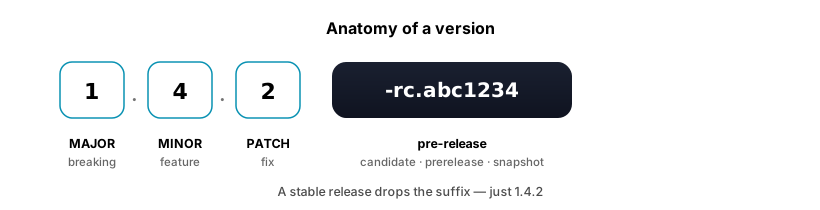
ERun versions are semver: MAJOR.MINOR.PATCH, e.g. 1.4.2.
- MAJOR — a breaking change.
- MINOR — a backward-compatible feature.
- PATCH — a backward-compatible fix.
A version can carry a pre-release suffix after a hyphen — 1.4.2-rc.abc1234. By semver rules a suffixed version sorts below the plain one, so 1.4.2-rc.1 and 1.4.2-snapshot-… are both "less than" the stable 1.4.2. ERun uses three suffixes (-rc., -pr., -snapshot-) to mark the non-stable kinds below; a plain MAJOR.MINOR.PATCH with no suffix is always the stable release.
The VERSION file
The base number lives in a VERSION file at the release module root (typically <tenant>-devops/VERSION). Builds resolve it by walking up from the build directory to the nearest VERSION, so a single project-wide file covers every component, but a component can carry its own.
VERSION always holds the next number to ship. Cutting a stable release tags the current number and then bumps VERSION to the next patch automatically — release 1.0.81, and VERSION moves to 1.0.82 for the work that follows.
main and develop
Two branches anchor the model (their names come from .erun/config.yaml → release.mainbranch / release.developbranch, defaulting to main and develop):
mainis the release branch. A release here cuts a stable version, tags it, publishes it, bumpsVERSIONto the next patch, and mergesmainback intodevelopso the bump propagates.developis the integration branch. A release here is a candidate (-rc.) — published for testing, but package-manager metadata (Homebrew, Scoop) is only updated for stable releases.
Any other branch (a feature or bug branch) produces a prerelease (-pr.).
The release cycle flows between the two branches — work integrates on develop, main cuts the stable release, and the version bump plus the merge flow back to develop:

develop; main cuts the stable release, then the bump and merge flow back.How a version is generated
When erun release runs (or CI runs it for you), it reads the base number from VERSION, looks at the branch, and produces one of four kinds:
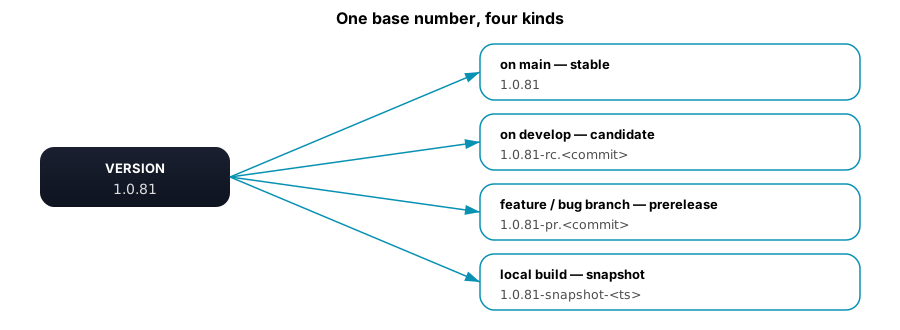
| Where it runs | Kind | Example | Published as |
|---|---|---|---|
main | stable | 1.0.81 | git tag v1.0.81, images, chart, package managers — immutable |
develop | candidate | 1.0.81-rc.<commit> | images + chart (no package-manager update) |
| feature / bug branch | prerelease | 1.0.81-pr.<commit> | images + chart |
a plain local build (no release) | snapshot | 1.0.81-snapshot-<timestamp> | only if pushed; disposable, for iterating |
<commit> is the short commit hash; <timestamp> is the UTC build time. The first three come from erun release; the snapshot is what a plain build mints by default when you're iterating, whatever the environment type (see the Delivery pipeline). A version is a content identity, and build is the only command that mints one — push and deploy take a version as input, they never create it.
Where next
- Delivery pipeline — where versions fit in the pipeline.
erun release— the command that cuts a version.- Release version policy — the exact version grammar, the regex, and the per-kind rules.
- Release flow — how CI drives releases end to end.